
For decades, search engines worked like digital librarians. You typed a few words, got a list of links, opened multiple tabs, compared information, and slowly found your answer.
That model is starting to disappear.
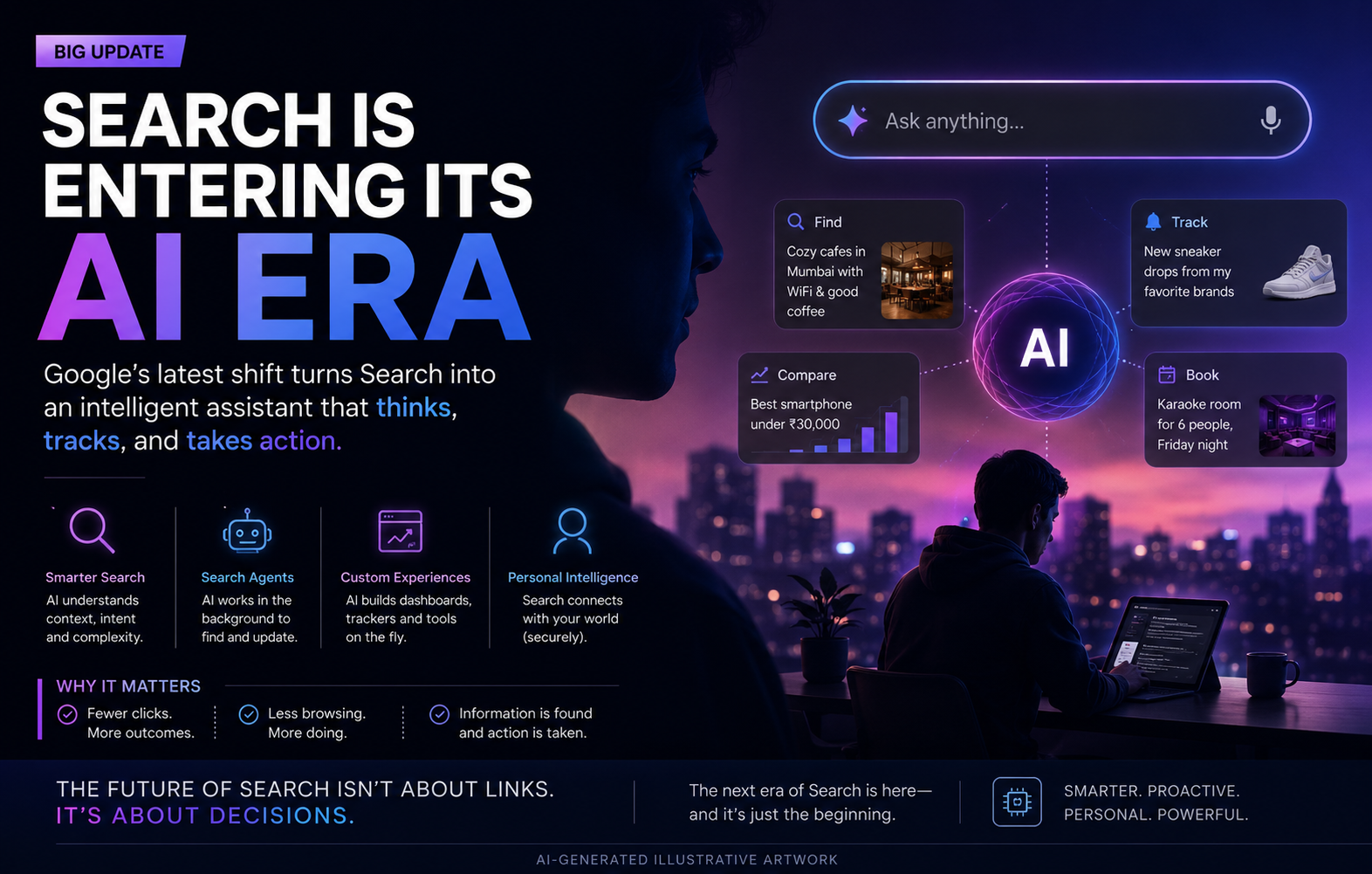
The latest wave of AI upgrades shows that search is evolving from a tool that finds information into a system that completes tasks, understands context, and continuously works on your behalf. This is not just a product update. It is a structural shift in how people interact with the internet itself.
Search Is Becoming an Operating Layer
The biggest change is not the AI chatbot interface. It is the idea that search no longer waits for instructions one query at a time.
Instead, it is becoming persistent.
Users can now describe complex goals naturally, continue conversations over time, connect personal context like emails or photos, and even deploy AI agents that monitor the web continuously. Search is evolving from reactive software into proactive infrastructure.
That changes user behavior entirely.
Instead of:
- searching repeatedly,
- opening multiple sites,
- comparing results manually,
people may increasingly expect one system to:
- understand intent,
- gather information,
- summarize findings,
- recommend actions,
- and eventually execute tasks.
The search engine is slowly becoming a digital assistant with memory.
Why This Matters More Than Another AI Launch
Most AI announcements focus on model intelligence. But the larger story here is interface dominance.
The company that controls how users access information controls the next phase of the internet economy.
Traditional search relied on clicks. AI-driven search relies on outcomes.
That sounds subtle, but it changes everything:
- websites may receive fewer direct visits,
- discovery becomes algorithmic rather than navigational,
- and brands compete to become part of AI-generated answers instead of just ranking on a page.
This creates a major shift for publishers, marketers, SaaS products, and even ecommerce businesses.
The fight is no longer only about ranking first.
It is about becoming the source AI systems trust, summarize, and surface automatically.
The Rise of “Invisible Browsing”
One of the most important signals from these announcements is that users may stop “browsing” the web in the traditional sense.
AI agents that monitor apartment listings, track product launches, compare prices, or even contact businesses remove the need for constant manual searching.
The internet starts moving in the background.
This introduces a new behavior pattern:
- fewer repetitive searches,
- fewer open tabs,
- less direct exploration,
- more delegated decision-making.
In other words, users may increasingly outsource digital effort itself.
That is a massive behavioral transition.
The winners in this environment are not necessarily the loudest brands. They are the businesses with:
- structured information,
- trusted authority,
- real-time data,
- and machine-readable ecosystems.
Search Is Becoming Personal Infrastructure
Another major shift is contextual intelligence.
Search engines historically understood queries. Now they are trying to understand the user.
Connecting email, calendars, photos, location signals, browsing context, and ongoing tasks transforms search from a public information tool into a personal operating system.
This matters because personalization dramatically increases dependency.
The more useful AI becomes in organizing your life, the harder it becomes to leave that ecosystem.
That creates enormous long-term strategic value:
- deeper user retention,
- higher subscription potential,
- stronger ecosystem lock-in,
- and richer behavioral data.
The future competitive advantage may not simply be the smartest AI model. It may be the AI with the deepest understanding of your daily life.
Search Results Are Turning Into Experiences
Another overlooked development is the move toward dynamic interfaces and mini-app generation directly inside search.
Instead of showing ten blue links, AI can now generate:
- trackers,
- dashboards,
- simulations,
- visual explainers,
- interactive tools,
- and personalized workflows.
This blurs the line between:
- search engines,
- software products,
- productivity tools,
- and app ecosystems.
Search is no longer just an entry point to the internet.
It is becoming the environment itself.
That creates pressure on startups and platforms whose value depended on being the destination users visited after searching.
The Bigger Trend Behind All of This
The internet is entering an “agentic” era.
In the past:
- humans searched,
- software responded.
Now:
- humans define goals,
- AI systems pursue them continuously.
This changes how information is consumed, how products are discovered, and how digital businesses compete for attention.
The next generation of successful companies may not optimize only for human users. They will optimize for AI intermediaries that increasingly shape what humans see, trust, and choose.
That is the real shift happening beneath these announcements.
What Happens Next
Search is no longer evolving into a smarter version of Google.
It is evolving into something closer to an intelligent digital layer sitting between humans and the internet itself.
The companies preparing for that future are not asking:
“How do we rank higher?”
They are asking:
“How do we stay visible when AI becomes the primary interface to the web?”