
There is a joke on Wall Street that EBITDA doesn’t actually stand for Earnings Before Interest, Taxes, Depreciation and Amortization. Instead some investors say it stands for Earnings Before I Tricked the Dumb Auditor.
It is a bit cynical. Like all good financial humor, it cuts close to the truth.
If you have read tech company S-1 filings looked at startup pitch decks or watched CNBC you have seen EBITDA. It is treated like the truth-teller of corporate health, a metric that shows you the pure engine of a business.
It isn’t the ultimate truth. In fact it is often an illusion.
To understand what a company is worth you have to understand what EBITDA is trying to show you why Wall Street likes it and what it hides.
What is EBITDA and Why Do We Use It?
At its simplest EBITDA is an accounting metric. It shows you how a business performs when you ignore how it is financed how the government taxes it and how expensive stuff it bought in the past.
Imagine you buy a coffee shop. The shop makes great money selling coffee. The previous owner took out a big loan to buy the espresso machines. If you look at the net income the business looks like it is losing money because of those interest payments.
EBITDA ignores that loan. It looks at the cash coming in from coffee sales minus the cost of beans, milk and wages.
The logic is simple: Interest rates change, tax codes vary by state, and old equipment eventually gets paid off. By ignoring these elements, EBITDA supposedly lets you compare that local coffee shop to a massive chain or a competitor down the street on an apples-to-apples basis. It isolates the operational engine.
How Startups and Tech Companies Use It to Hide Losses
As the tech boom took over EBITDA changed from a tool into a shield for unprofitable companies.
Think about a startup. A company builds a software platform. In the years they lose a lot of money. They spend millions on engineering, server costs and marketing. If they showed investors their net income everyone would be scared.
So they point to EBITDA. Its cousin: Adjusted EBITDA.
By adding back stock-based compensation and one-time marketing blitzes a company that lost $500 million can claim it is “EBITDA ” We saw this with companies like WeWork and Uber. WeWork invented “Community Adjusted EBITDA,” which ignored the rent they had to pay.
When a company talks more about its EBITDA than its revenue they are telling a story. They are asking you to believe in a future where the messy realities of running a business disappear.
The Big Blind Spot: Real Equipment Wears Out
Warren Buffett asked: “Does management think the tooth fairy pays for capital expenditures?”
This gets to the spot of EBITDA: the “D” and the “A” Depreciation and Amortization.
Depreciation isn’t a fake accounting trick. It represents things wearing out. If you run a delivery business your trucks will break down. If you run a cloud computing company your servers will become obsolete. You can’t run the business without replacing them.
When you use EBITDA you are pretending that those future costs don’t exist. You are ignoring the fact that the company will have to write a check just to keep operating.
Consider an example like a semiconductor plant or an AI startup buying Nvidia chips. Those chips have a life; they will be obsolete in a few years. Ignoring that depreciation isn’t just optimistic; it is financially irresponsible.
Furthermore, EBITDA completely ignores working capital. It doesn’t care if your cash is trapped in unsold inventory sitting in a warehouse or if your customers are taking 90 days to pay their invoices. A company can look incredibly healthy on an EBITDA basis while simultaneously running out of cash to pay its rent next month.
Why It Fails to Compare Different Kinds of Businesses
The promise of EBITDA was that it allowed for comparisons across industries.. In the modern economy it often does the opposite.
Compare a manufacturing company to a modern software-as-a-service platform. The manufacturer has physical assets that depreciate over twenty years. The SaaS company has no physical assets but it might spend tens of millions of dollars on software development.
When you look both through the lens of EBITDA the structural differences between how these two businesses survive and scale get warped.
Worse EBITDA has become a playground for creative accounting. Because it is a non-GAAP metric, corporate finance teams have leeway in how they calculate it. They can decide what constitutes an “one-time expense” and add it back to make the numbers look pretty.
If a company has to restructure its workforce every single year, is that really a “one-time restructuring cost”? Probably not. But label it as such, add it back to EBITDA, and suddenly the executive bonuses are triggered and the stock price ticks upward.
The Verdict: Cash Flow is the Real Truth
None of this means EBITDA is useless. It has its place. If you are an operations manager trying to figure out if your factory floor is running efficiently looking at EBIT or EBITDA makes sense.
If you are an investor an employee with equity or an observer trying to understand the economic reality of a business EBITDA can’t be your destination. It can only be a starting point.
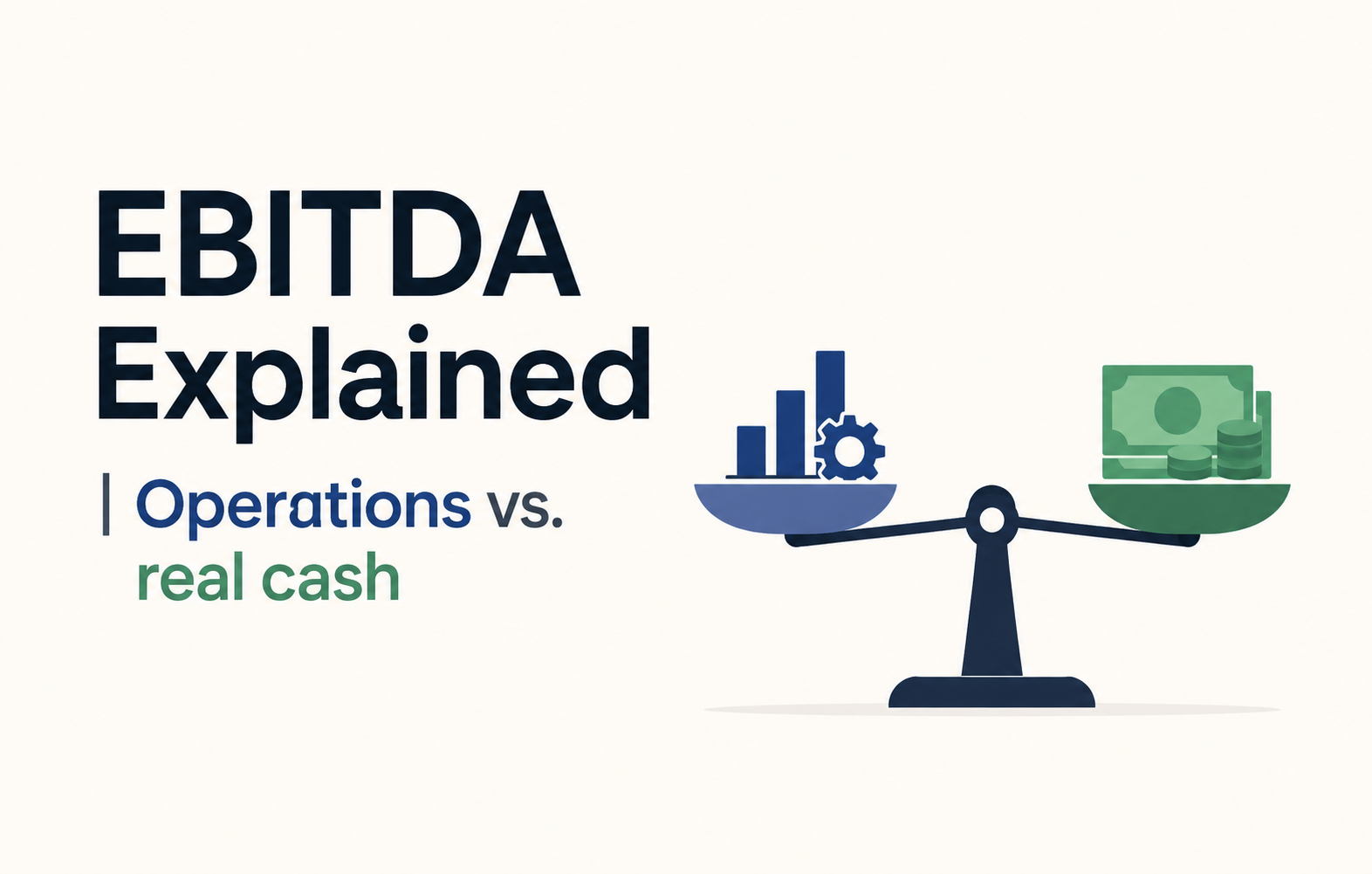
The ultimate truth in business isn’t EBITDA. It isn’t even net income. It is cash flow, the actual amount of cash a company has left over after paying all its bills, taxes, interest and buying new equipment. Cash doesn’t lie. It can’t be. Massaged by a clever CFO.
The next time a founder or executive flashes a slide showing an upward-trending EBITDA curve admire the marketing. Then ask to look at the cash flow statement. That is where the real story is written.
The Main Insights Take
- Operational Focus: EBITDA is useful for isolating a company’s core operational performance by ignoring the distractions of tax strategies, debt structures, and historical asset purchases.
- The Tooth Fairy Fallacy: By ignoring depreciation and amortization, EBITDA pretends that equipment, technology, and infrastructure never wear out or need replacing. This masks the heavy, inevitable capital costs required to keep a business running.
- The Adjustment Trap: Because it is not a strictly regulated accounting standard, companies frequently manipulate “Adjusted EBITDA” to hide recurring losses, stock-based compensation, and everyday business expenses.
- Cash is King: EBITDA is an opinion; cash flow is a fact. High EBITDA can easily coexist with a business that is structurally unprofitable and running out of money. Always look at free cash flow to find the economic reality.