
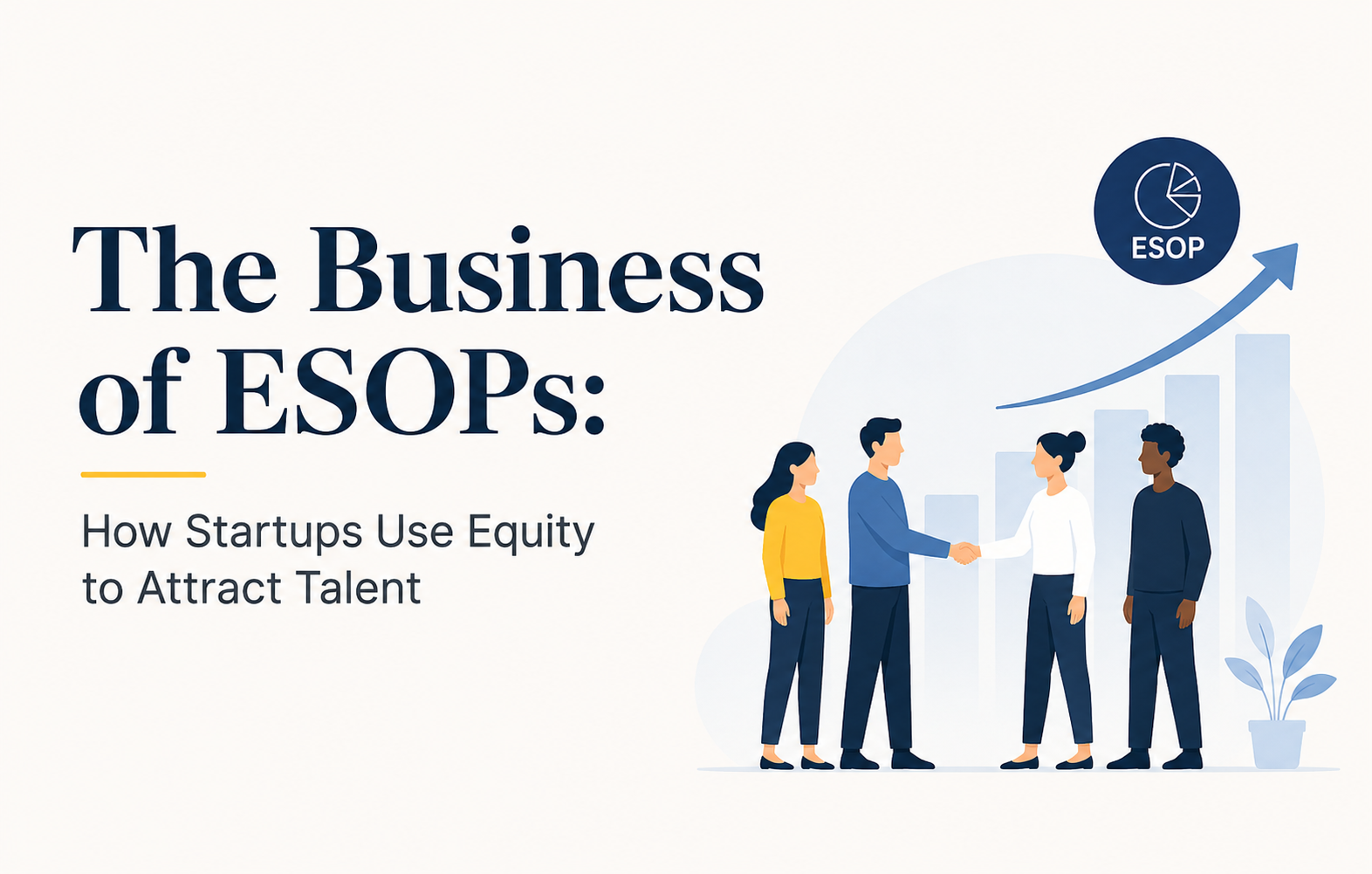
In the stages of building a company founders often face a big problem: they don’t have much money but they have big dreams. Hiring people is no longer just about who can pay the most. It’s about who can offer something more valuable.
This is where ESOPs. Employee Stock Ownership Plans. Have quietly become a tool in the startup world.
Today giving employees a share of the company is not just part of the job offer. In cases it’s the whole offer.
What Changed: Equity Moved to the Center of Compensation
Over the past decade ESOPs have become more important.
Earlier startups used equity as a benefit. Something offered alongside salary to make jobs more attractive.. Employees often didn’t understand it and prioritized getting paid immediately.
That has changed.
As startup ecosystems grew globally employees began to see results. Like when companies went public or were bought out and employees got to sell their stock options for real money. Equity was no longer an idea; it became something real.
At the time market conditions forced startups to rethink their priorities. Capital became more scarce funding cycles unpredictable and startups more focused on growing sustainably. This made it harder to justify paying salaries.
Equity became a solution. Not just to save cash but to align everyones goals.
The result: ESOPs moved from being a part of startup compensation to a central part.
Why It Matters: Ownership Changes Incentives
At its core ESOPs are a tool.. Their real impact is on how people behave.
When employees own a piece of the company, a small one their perspective shifts. Work is no longer a transaction. It becomes a shared effort.
Ownership encourages people to think term. It aligns effort with company goals. It also introduces a kind of accountability. One that is not enforced, but internalized.
This is particularly important in startups, where uncertainty’s high and outcomes are not guaranteed. Founders need teams that’re resilient, invested and willing to navigate ambiguity.
Equity helps build that mindset.
However this only works when there is clarity and trust. If employees understand how their equity works. Vesting, valuation, liquidity. It becomes an incentive. Without that understanding ESOPs risk being perceived as promises with unclear value.
In words the effectiveness of equity depends as much on communication as it does on allocation.
Industry Impact: A New Playbook for Talent Acquisition
The competition for talent has become global and uneven.
Large companies offer stability, structured growth and high cash compensation. Startups by contrast operate with constraints.. Also with flexibility.
ESOPs allow startups to reframe the value proposition.
Of competing on salary alone they compete on potential. The opportunity to participate in value creation becomes a differentiator. For employees who are willing to trade short-term certainty for long-term upside.
This has reshaped hiring strategies.
Startups are now able to attract professionals who might previously have preferred established organizations. Equity bridges that gap by offering a stake in the outcome not a role in the process.
Retention dynamics are also evolving. Vesting schedules. Typically spread over years. Create natural incentives for employees to stay and contribute through key growth phases.
At the time expectations are rising.
Employees today are more informed. They ask questions: What is the strike price? What is the company’s valuation? When will liquidity be available?
In response companies are adapting.
We are seeing the emergence of liquidity options. Including secondary sales and periodic buybacks. That allow employees to realize value without waiting for a full exit. This marks a shift toward making equity not just attractive, but practical.
The Complexity Behind the Promise
Despite their advantages ESOPs are not straightforward.
For companies designing an ESOP pool requires careful calibration. Little equity and it fails to motivate. Much and it leads to excessive dilution for founders and early investors.
There are also tax considerations that vary across markets adding another layer of complexity.
For employees the challenge lies in understanding what they are being offered.
Equity value is not fixed. It depends on company performance, market conditions and eventual liquidity events. In cases employees may hold options for years without a clear path to monetization.
This introduces risk. One that is often underestimated.
As a result education is becoming a part of ESOP strategy. Companies that invest in explaining how equity works. In transparent terms. Are better positioned to build trust and engagement.
Clarity in this context is not good practice. It is an advantage.
A Broader Shift: From Compensation to Wealth Creation
One of the important implications of ESOPs is their role in expanding access to wealth creation.
Traditionally the financial upside of building companies was concentrated among founders and investors. ESOPs redistribute a portion of that value to employees enabling participation in growth.
This has effects.
Employees who benefit from equity gains often go on to become founders angel investors or early employees in ventures. This creates a cycle of reinvestment that strengthens the startup ecosystem.
In emerging markets, where startup ecosystems are scaling rapidly this can have an impact on economic mobility and innovation.
However the extent of this impact depends on how ESOPsre structured.
If equity distribution is concentrated among a group the broader benefits are limited. If designed inclusively ESOPs can serve as a mechanism for shared value creation.
The Future of ESOPs: Toward Standardization and Liquidity
Looking ahead ESOPs are likely to become structured more transparent and more liquid.
Several trends point in this direction.
First standardization is improving. As more companies adopt ESOPs best practices are emerging around allocation, vesting and communication.
Second liquidity is becoming a priority. The traditional model. Where employees wait for an IPO or acquisition. Is gradually evolving. Secondary markets and company-led buybacks are making it easier to unlock value earlier.
Third regulatory frameworks are adapting. Policymakers are increasingly recognizing the role of employee ownership in driving innovation and economic growth. Simplified tax structures and compliance processes could further accelerate adoption.
Finally cultural expectations are shifting. Equity is no longer seen as optional in startup roles. It is becoming an expectation, particularly for high-growth companies.
Together these changes suggest that ESOPs are moving beyond compensation. Toward becoming an element of how startups are built and scaled.
Equity as a Strategic Mindset
The rise of ESOPs reflects an evolution in the relationship between companies and employees.
In a world defined by change and global competition traditional compensation models are no longer sufficient. Startups need teams that’re not just skilled but aligned. Not just employed, but invested.
Equity provides that alignment.
Its true value lies beyond financial upside. It lies in creating a shared sense of purpose. A belief that building something is a collective effort and that success when it comes is shared.
For startups navigating uncertainty that alignment may be one of their powerful advantages.
The Main Insights Take
ESOPs are no longer a hiring tool. They are a reflection of how modern companies think about ownership, incentives and long-term value creation. As the startup ecosystem matures the winners will not be those who offer the equity but those who structure it transparently communicate it clearly and connect it meaningfully to outcomes. In the end equity works best not as a promise of wealth. As a mechanism for alignment. Turning employees into stakeholders, in both risk and reward.