
Disclaimer: The economic and statistical data featured in this article is compiled directly from official Indian government notifications and public records. This commentary is intended solely for educational and general informational purposes.
Open up any business news app on your phone right now. What do you see? It is a constant flood of the exact same stories. You get breaking updates on massive venture capital rounds, shiny new tech unicorns, stock market records, and flashy generative artificial intelligence tools. We click on them because they show where the big corporate money is moving.
But there is a massive catch. These glitzy headlines end up painting a pretty warped picture of how India’s economy actually ticks. While the mainstream press stays completely obsessed with a tiny group of hyper-visible corporate giants, a massive business network is silently doing the heavy lifting out of sight. It is this quiet, backstage engine that manufactures everyday goods, drives regional employment, ships cargo abroad, and keeps vital supply chains moving across the country day in and day out.
Right at the absolute center of this entire ecosystem is the Indian MSME sector.
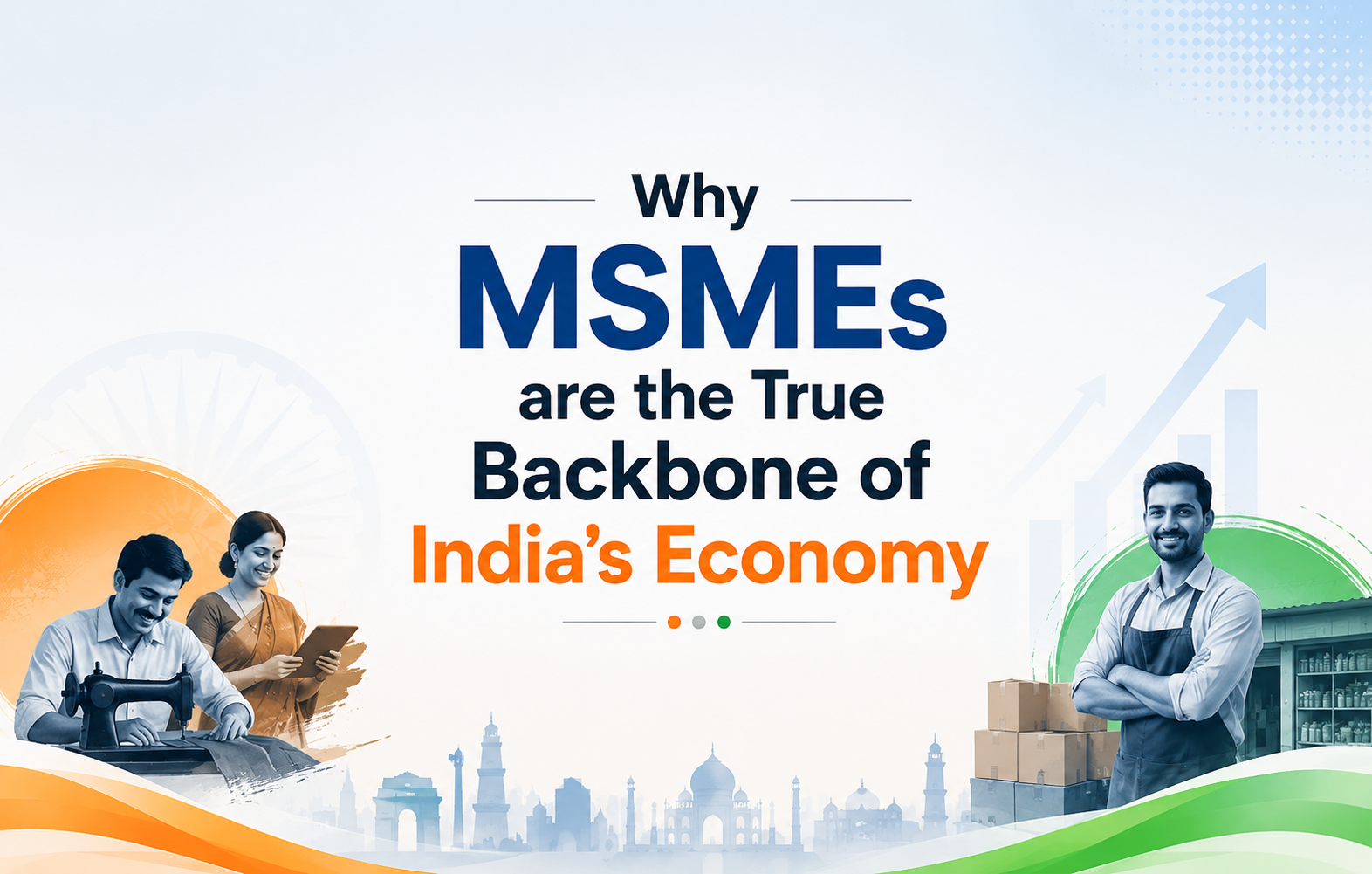
The sheer scale here is mind-blowing. If you look at the live tracking on the government’s official MSME Dashboard, India has now crossed the mark of 7.8 crore registered Micro, Small, and Medium Enterprises. Furthermore, official insights published in the Economic Survey by the Press Information Bureau reveal that these exact businesses drive a staggering 31.1% of the country’s GDP and fuel nearly 48.58% of total exports. According to the latest data from the PIB Rural & Semi-Urban MSME Report, they keep over 32.8 crore people employed. Yet, despite this massive footprint, they barely get a fraction of the media coverage showered on venture-backed startups.
Growth Happens Far From the Corporate Spotlight
When analysts argue about economic progress, the conversation always jumps to high-tech corridors, giant factories, or sprawling infrastructure projects. They matter, obviously. But real, everyday economic momentum does not just come from corporate boardroom mandates. It is built on millions of micro-decisions made by everyday small business owners every single morning.
Think about a small local workshop upgrading its machinery. Or a neighborhood manufacturer bringing on ten new workers. Maybe it is a regional service business branching out into the next town over. Individually, these moves look small. Multiplied across the country, they create an economic tidal wave. That is exactly what MSMEs do.
India has a massive employment puzzle to solve. Every single year, millions of young people join the workforce hunting for stable pay, steady growth, and long-term security. Outside of traditional farming, small businesses have quietly stepped up as the nation’s primary job engine, keeping more than 32.8 crore people employed.
The positions keeping families afloat across tier-2 cities, tier-3 cities, and rural hubs are not coming from major tech campuses. They are created by small, independent operations working far outside the limelight. They act as the literal backbone of our communities.
The Hidden Machinery of Indian Manufacturing
People often assume that big brands manufacture everything under their own roofs. That is a myth. Modern industrial production is completely reliant on deep, interconnected supplier webs.
Walk through any industrial cluster and you will see small firms machining precision components, treating raw materials, handling custom packaging, and sorting out complex engineering bugs. In fact, they handle over a third of India’s total manufacturing output. If these small links break, the big factory assembly lines grind to a halt. Costs skyrocket. Growth stops.
Global Trade is Powered by Local Names
We usually tie export success to global brands with massive marketing budgets. The reality on the ground tells a completely different story. Nearly half of all goods shipped out of India come straight from small and medium firms.
Operating out of regional hubs and special economic zones, these businesses quietly produce items that travel thousands of miles to international buyers. It proves a vital point: you do not need a corporate skyscraper to compete globally. You just need deep specialization, quality control, and consistency.
Go back a decade, and growing a business meant you needed deep pockets for supply chains, physical storefronts, and massive ad campaigns. Not anymore.
Cheap internet access, instant digital payments, cloud tools, and online marketplaces have systematically broken down those old entry barriers. Today, a small workshop can sell to buyers three states away, streamline their inventory online, and chase deals that used to be preserved for corporate giants. This digital shift does not always make the evening news, but it has fundamentally rewritten the rules for small business growth.
The Secret Tech Support System
The startup world loves to see itself as a standalone universe powered entirely by code, venture capital, and disruption. But look under the hood. The relationship is deeply codependent.
Behind almost every fast-growing digital app or e-commerce platform is a physical grid of manufacturers, delivery partners, and material suppliers. Most of them are MSMEs. Apps can take orders, but physical goods still need to be built, packed, tracked, and shipped. Even the most forward-thinking business models rely on traditional workshops to keep their promises.
Pure Adaptability as a Superpower
If there is one trait that defines small business owners, it’s resilience. Massive corporations can rely on deep financial safety nets, but small firms have to survive on pure agility.
An independent business owner has to pivot instantly when customer tastes shift, raw material costs spike, or shipping routes get messed up. They adapt because failure is not an option. Operating on razor-thin margins means becoming an expert, fast-moving problem solver. This grit is what keeps people employed even when the broader economy hits a rough patch.
Moving Beyond the Valuation Myth
Our business media is obsessed with funding announcements as the ultimate proof of success. A massive investment round creates instant viral buzz. Meanwhile, thousands of regular businesses are scaling up production, hiring locals, and balancing their books without a single tweet.
An entrepreneur buying an extra delivery truck or adding a second shift does more for local economic health than a tech firm burning through capital. True progress is not found in paper valuations. It lives in payrolls, real productivity, and actual profit.
Designing India’s Economic Tomorrow
India’s national goals are incredibly ambitious. Expanding factories, boosting exports, and driving digital adoption are central to the country’s next big leap. But big corporations cannot carry this weight alone.
Real economic transformation demands an army of suppliers, specialized machine shops, distributors, and logistics providers working in sync. Simply put, it requires a thriving MSME sector. These small-scale business owners might never become household names, but their impact is going to be impossible to ignore.
Giving Credit Where It’s Long Overdue
Modern business media likes stories that fit neatly into an online headline. Big valuations and celebrity founders bring in clicks. Small firms do not fit that mold. A factory owner hiring fifty people or expanding their floor space rarely goes viral.
Yet, those exact events are what dictate the health of local communities and long-term economic stability. When a single sector drives nearly a third of the country’s GDP and half its trade, it deserves more than a passing mention during policy speeches.
Let’s face the facts. The Indian economy is not held up by a handful of celebrated tech unicorns. It’s built by millions of everyday entrepreneurs building real things, opening up local opportunities, and tackling practical challenges. They might not win the headline war, but they are the rock-solid foundation holding up the entire house.
Main Insights Take
- India’s network of over 7.8 crore registered MSMEs forms one of the largest, most active business ecosystems on Earth.
- This sector drives roughly 31.1% of national GDP and commands 48.58% of India’s export trade
- By supporting over 32.8 crore jobs, these enterprises stand as the country’s biggest employer outside of traditional farming.
- Heavy industries, shipping logistics, global trade, and retail supply lines are all deeply dependent on small business activity.
- Accessible digital technology has flattened the playing field, unlocking massive new markets for regional workshops.
- Mainstream financial media routinely ignores these small firms, choosing to focus almost entirely on tech startups and big conglomerates.
- At the end of the day, India’s grand economic future depends entirely on keeping this small business foundation healthy and growing.