
Every time a package lands at your doorstep in ten minutes someone somewhere made a costly and clever decision about where to put a building.
India is obsessed with the glamorous end of commerce. The apps. The founders. The funding news. The valuation goals. Read any business news. You’ll see exciting stories about consumer platforms, direct-to-consumer brands growing and fintech companies changing how money works. You rarely find a talk about the not-so-exciting infrastructure that holds everything together.
Warehouses. Cold rooms. Fulfilment centres. Distribution hubs.
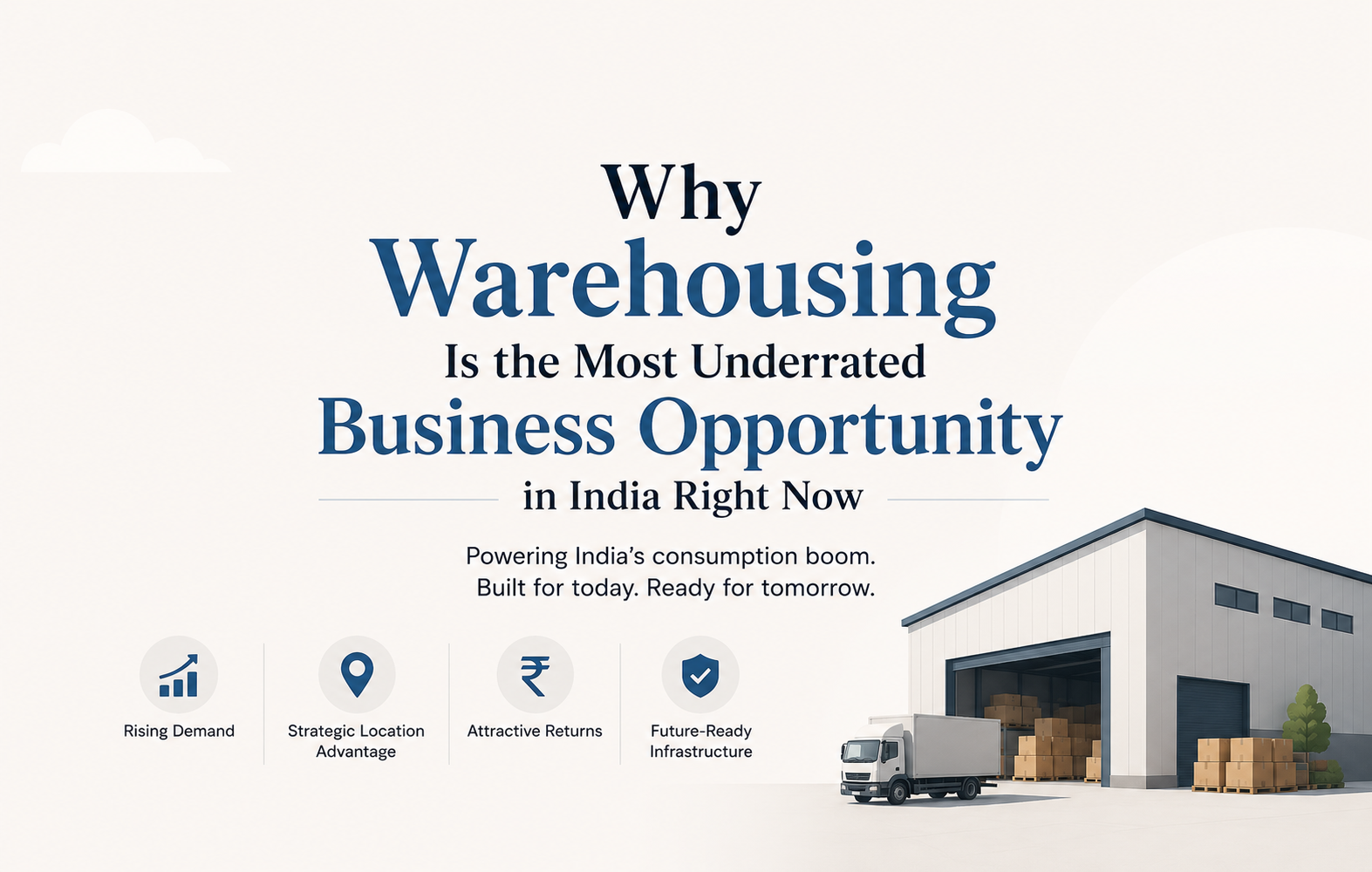
No one shares a press release about a large facility on the outskirts of a small city on social media with excitement. There’s no moment when a warehouse is built. The industry doesn’t have a founder giving TED talks about changing the world. Yet quietly without much attention warehousing has become one of the most important and undervalued business opportunities, in India today.
The Secret Power Behind Your Online Orders
When you buy something have you ever thought about what really happens? A company sells its product on its website, a big marketplace, a beauty site and a quick delivery app all at once. Each of these places needs to have the product stored close to you. The product doesn’t just magically appear. Its kept in a building on a shelf. Software helps manage it. A person or a machine picks it. Its packed into a box. Given to a delivery person.
That building is called a warehouse. Now in India there aren’t enough warehouses. They are not in the places and are not built correctly. There’s a difference, between whats available and what Indian online shopping needs. Many brands that sell directly to customers face the issue when they grow. Their delivery gets irregular. Returns start piling up. How long it takes to deliver varies depending on where you live. The product itself is usually okay. The problem is the warehouse.
What Quick Commerce Did to the Logic of Storage
Before the rise of commerce the way we thought about storage in India was pretty straightforward. We would build a warehouse near a highway close to a major city with good roads to connect it. That was the idea. Quick commerce changed all of that.
The idea of delivering something in ten minutes does not work if you have a warehouse on the outskirts of a city. It only works if you have a warehouse right inside the city close enough to the customer that a delivery person can get there in under ten minutes on a two-wheeler. Of having one big warehouse in a city we need to have fifteen to twenty small warehouses in different neighborhoods. Each of these warehouses is an operation that needs to be set up managed and run with precision. It is very complicated to run a network like this. The decisions we make about where to put these warehouses are very important. Someone has to build, rent and manage all of them.
The Cold Chain Gap Is a National Scale Problem
There is something that should make us uncomfortable when we think about commerce in India. Our country produces an amount of fruits, vegetables and other perishable goods every year. A lot of these goods never reach the people who want to buy them. This is not because people do not want to buy them or because farmers did not grow them. It is because we do not have cold chain infrastructure to keep these goods fresh from the farm to the store.
Cold chain means we need to have refrigerated storage, special vehicles and facilities that can keep goods at the temperature from the time they are produced until they are consumed. India has some of this infrastructure but not enough. The difference between what we have and what we need is very big. This is not a problem of wasted food but also a problem of wasted money. Companies that have cold chain facilities can charge high prices because so many people want to use them. Building cold storage infrastructure in India is a very good business idea right now.
- It is an idea to build cold storage facilities in India because there is a high demand for them.
- We need to have cold chain infrastructure to reduce food waste and economic waste.
- Quick commerce has changed the way we think about storage, in India. We need to adapt to these changes.
Why Most Existing Warehouses Don’t Actually Work
Most people don’t really understand what modern warehousing needs. A good warehouse needs to be tall enough to have levels of shelves. It needs systems to put out fires. The floor needs to be strong and smooth so that heavy machines don’t break it. The loading and unloading areas need to work with trucks. There needs to be a power supply with backup systems.. Workers need basic but functional facilities.
These aren’t requirements. They’re standard. Many warehouses in India don’t meet them. They are buildings that are being used for storage. They don’t have power. The floors can’t handle machines or the ceilings are too low for shelves. When a serious business wants to expand they can’t find good warehouses in the right places. Developers who build warehouses can’t keep them in stock because the other options don’t work for managing inventory.
The Tax Reform That Changed Everything
Before India changed its tax system warehouses were built based on state taxes. Companies would build warehouses in states with taxes and ship goods long distances to save money. Everyone knew it was inefficient. The taxes made it make sense.
When the tax system changed everything changed. Companies could build warehouses based on logistics. Being close to customers having roads having workers available and land costs. They didn’t have to think about taxes. Many companies consolidated their warehouses from small ones to a few bigger and better ones. This made them want warehouses in good locations. There aren’t enough of those. Years later the change in demand, from the tax reform still hasn’t been met with supply.
Technology Is Making This More Interesting Than It Used to Be
Warehousing was simple which made it not very interesting to some investors and entrepreneurs. It needed a lot of people and processes the profits were small. It was not very challenging. This is changing every year.
The software used to manage warehouses is now really advanced. These systems can figure out the place to store products in a warehouse so that workers do not have to walk too far during their shift. This makes a difference in how much work gets done. The products that are ordered the most can be stored near the packing area. It is easier to get them ready to ship. Robotics is starting to be used in warehouses and it is going to become more common.
The cost of labor in India is low. It is not yet worth it to fully automate warehouses. New warehouses are being built with the idea that they will use machines in the future. They are designing the floors and power systems to work with robots because it is cheaper to do it this way than to try to change a warehouse to use robots. This is a decision that is being made when the warehouse is first built because it is expensive to change an old warehouse to work with robots. Warehousing and warehouse management software are becoming more complex and interesting with the use of warehouse management software and robotics, in warehousing.
The Tier 2 and Tier 3 Frontier
People who follow business know that the next big thing in consumer growth is not happening in the big cities. It is happening in the cities where people are using the internet and buying things online for the first time. They are getting used to delivery because of apps made for city people. The problem is that these smaller cities do not have good delivery systems in place.
In many of these places the only options for storing things are old and not very good. Sometimes it is even hard to find a place to keep things cool. If someone builds a storage place in one of these cities lots of people will want to use it. Online shopping companies want to be able to deliver things from these cities. Brands want to be closer, to the people who are buying their things. Food companies need storage. Companies that deliver medicine need special storage. There are not good storage places available. So the people who own these storage places can charge a lot of money. This will not last forever because more people will build storage places and the problem will get fixed. For now people who are willing to wait and work hard can really benefit from this situation.
Why Nobody Is Talking About This
The truth is that warehousing does not fit the story that Indias business media likes to tell. There is no person who started the company with a great story. The product is not something that people use every day. You do not need to download an app to use it. The way the business works. Renting land building a place and renting it out. Is not exciting. Does not make for a good story that people want to read about.
What warehousing does offer is an stable business that makes money and is backed by real things like buildings. Indias commerce is getting bigger. More stores are being set up. Products are being delivered in a more organized way. People want their things delivered faster and faster. All of these things mean that India needs places to store things and it needs them to be in good locations. The opportunity to make money from warehousing is real. It does not need to be exaggerated. It just needs people to notice the things, about warehousing and the opportunities that warehousing offers.
The Main Insights Take
Warehousing in India is a business that makes every business work. It’s still really affordable. Many platforms are growing fast. Brands are expanding their delivery networks. Delivery apps are promising to deliver in ten minutes. All these depend on warehouses. There aren’t enough warehouses. Most investors are focused on apps. They ignore the warehouses that apps rely on. This difference, between how important warehousesre how much attention they get is where big opportunities exist. Warehouses may not be exciting. Without them none of the other businesses can work.