
For years, artificial intelligence has been marketed as a productivity tool, something that writes emails faster, summarizes documents, or generates images. But the next phase of AI is becoming far more ambitious.
The latest shift coming from Google signals something bigger: AI is now moving from assisting knowledge workers to actively participating in scientific discovery itself.
And that changes the role of technology in society entirely.
Research Is Breaking Under Its Own Weight
Modern science has a scale problem.
Millions of research papers are published every year. New datasets grow faster than humans can process them. Scientists spend enormous amounts of time reading literature, comparing findings, testing possibilities, and organizing fragmented information before they can even begin making breakthroughs.
The real bottleneck in science is no longer access to information.
It is synthesis.
That is where AI is starting to matter most.
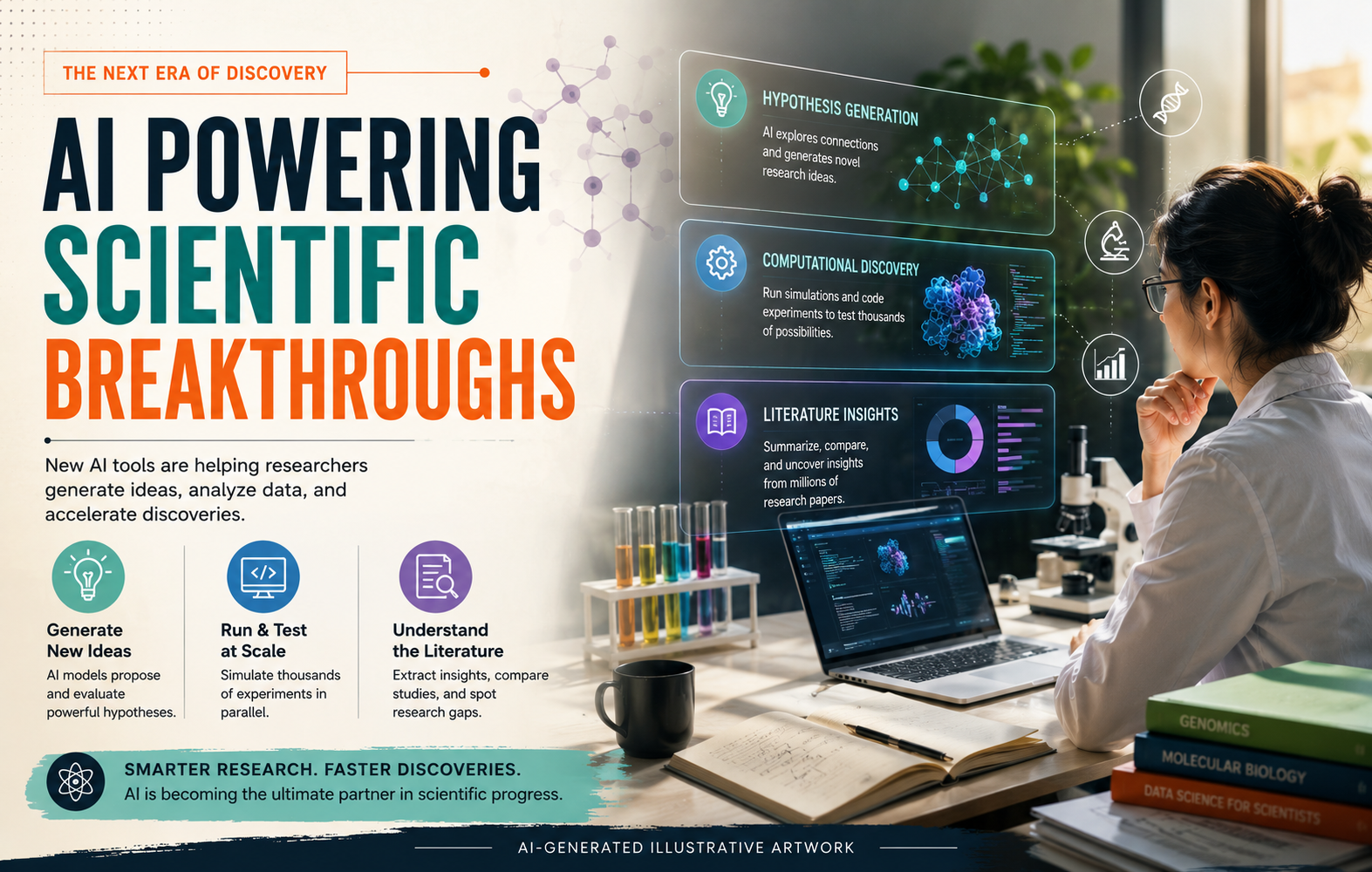
Instead of positioning AI as a chatbot for researchers, Google’s new science-focused systems aim to automate parts of the scientific method itself, from generating hypotheses to analyzing literature and running computational experiments.
This is a major transition.
AI is moving beyond answering questions. It is beginning to help frame the questions humans should ask next.
The Rise of “Idea Engines”
One of the most important shifts here is the emergence of AI systems that can generate and evaluate scientific possibilities at scale.
Traditionally, scientific progress depended heavily on human intuition: connecting unrelated findings, spotting patterns, or proposing theories others missed.
But humans are limited by time and cognitive bandwidth.
AI systems trained across massive scientific datasets can now scan millions of relationships simultaneously, uncovering connections researchers may never encounter manually.
That creates a new kind of competitive advantage in science:
not just intelligence, but accelerated curiosity.
The organizations that discover faster may soon outperform those with simply larger teams or bigger budgets.
Why This Matters Beyond Laboratories
This development is not just about universities or researchers.
It reflects a broader economic trend where AI becomes deeply embedded into industries built on complex problem-solving.
Pharmaceuticals, climate modeling, biotech, manufacturing, agriculture, energy, and materials science all rely heavily on experimentation cycles that are slow, expensive, and data-heavy.
If AI can shorten those cycles from months to days, entire industries could compress innovation timelines dramatically.
That changes business economics.
Products could reach markets faster.
Research costs could decline.
Smaller teams could compete with larger institutions.
And countries investing early in AI-assisted science may gain a significant strategic advantage.
This is why major technology companies are increasingly treating scientific infrastructure as a long-term platform opportunity rather than a niche research project.
The Bigger Shift: AI as a Cognitive Infrastructure Layer
What makes this moment important is not a single tool or announcement.
It is the direction.
AI is evolving into a cognitive infrastructure layer, a system that sits underneath research, education, engineering, and decision-making.
In earlier internet eras, technology helped humans access information faster.
Now AI aims to help humans generate knowledge faster.
That distinction matters.
Search engines organized the web.
AI research systems may organize human understanding itself.
And once that happens, the competitive landscape changes for everyone:
universities, governments, startups, healthcare systems, and even individual researchers.
The gap between those using AI-assisted discovery and those relying entirely on traditional workflows could become enormous over the next decade.
Education May Change Faster Than Expected
There is another overlooked implication here: education.
Students and young researchers historically struggled because access to advanced research workflows was limited to elite institutions with large funding and specialized infrastructure.
AI changes that equation.
Tools capable of summarizing literature, explaining complex concepts, identifying research gaps, and simulating experiments could democratize high-level scientific work for smaller universities and independent researchers.
This does not eliminate expertise.
But it lowers the barrier to entry.
The result could be a new generation of researchers who spend less time gathering information and more time interpreting it creatively.
The Future Isn’t AI Replacing Scientists
The real story is not machines replacing researchers.
It is researchers working alongside systems that dramatically expand their ability to think, test, compare, and explore.
Scientific discovery has always depended on tools, microscopes, computers, databases, simulations.
AI may become the next foundational scientific instrument.
Not because it “knows” science better than humans,
but because it can navigate complexity at a scale humans alone cannot.
And in a world overflowing with information, the ability to synthesize knowledge may become the most valuable capability of all.