
In the early stages of building a company, founders often obsess over the product. They spend sleepless nights refining features, perfecting the user interface, and engineering elegant solutions to complex problems. While product excellence is critical, a great product without a viable business model is just an expensive hobby.
A business model is the actual engine of your enterprise. It determines how your product survives, scales, and delivers long-term value to shareholders. Understanding the architecture of business models is not just an academic exercise; it is a strategic requirement that separates sustainable companies from failed experiments.
Defining the Business Model
At its core, a business model is a conceptual framework that explains how a company creates, delivers, and captures value. It is the blueprint that outlines how your organization operates, who it serves, what problem it solves, and crucially, how it generates a profit.
Author and business theorist Alexander Osterwalder, creator of the Business Model Canvas, famously broke this down into nine distinct building blocks. However, for a founder at the starting line, the concept can be distilled into three fundamental questions:
- How do you create value? What is your unique value proposition, and what problem are you solving for which specific customer segment?
- How do you deliver value? What channels, supply chains, and operational structures do you use to get that solution into the hands of the customer?
- How do you capture value? What is your pricing strategy, revenue model, and cost structure that ensures a healthy profit margin?
A business model is distinct from a business plan. A business plan is a static document detailing goals, financial forecasts, and marketing strategies over a set timeline. A business model is a dynamic, structural logic. It is the economic DNA of your company.
Why the Business Model Dictates Destiny
Many founders mistake a monetization strategy for a business model. Charging a customer $10 a month is a revenue model; building the infrastructure, retention loops, and margin profiles to sustain that $10 charge is a business model.
Choosing the wrong model can sink a brilliant product. For instance, if you build a high-touch hardware product that requires intense customer education but price it like a low-touch software utility, your unit economics will collapse under the weight of your Customer Acquisition Cost (CAC). Conversely, selecting the right model unlocks powerful network effects, predictable cash flows, and defensive moats that protect you from competitors.
As markets mature and technology evolves, the underlying models change. The founders who win are those who match their product innovation with business model innovation.
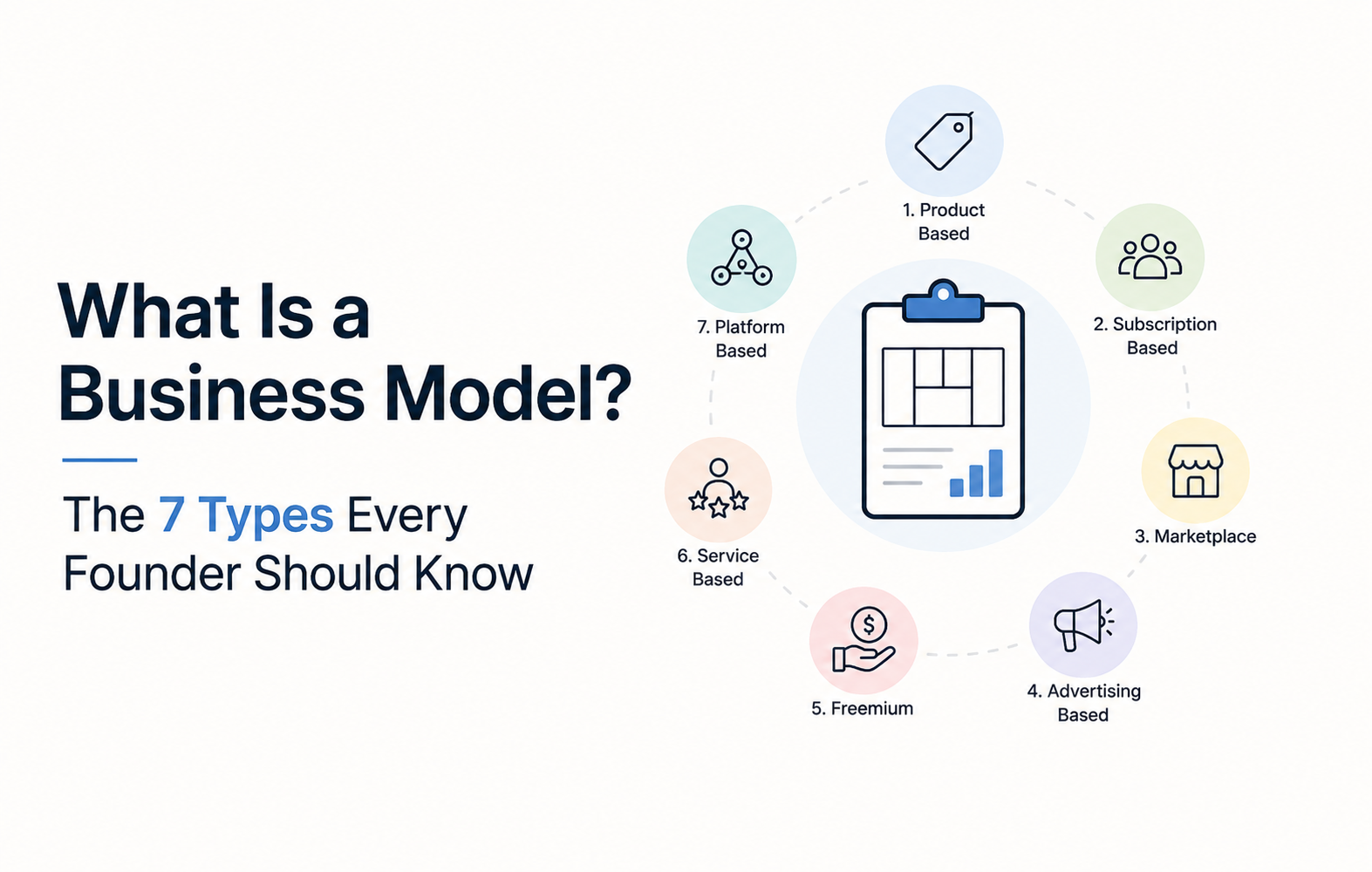
The 7 Core Business Models Every Founder Must Know
While there are countless variations and hybrid structures, almost every modern business operates on one of these seven foundational models.
1. The Subscription Model
The subscription model charges customers a recurring fee at regular intervals (monthly or annually) for continued access to a product or service. Once primarily used by magazines and utilities, it has become the dominant paradigm of the modern digital economy.
- How it works: You shift the customer relationship from a one-time transaction to an ongoing relationship. Value must be delivered continuously to prevent customer turnover (churn).
- Primary metrics: Monthly Recurring Revenue (MRR), Lifetime Value (LTV), and Churn Rate.
- Real-world examples: Netflix, Spotify, Salesforce.
- Founder’s takeaway: The subscription model offers immense financial predictability and high valuations from investors. However, it requires a significant upfront investment to acquire customers, meaning you must have the cash runway to survive a longer payback period.
2. The Freemium Model
A blend of “free” and “premium,” this model offers a basic version of a product or service to users for free, while charging a premium for advanced features, higher usage limits, or an ad-free experience.
- How it works: The free tier acts as a frictionless marketing tool to drive massive user acquisition. A small percentage of these free users eventually upgrade to paid tiers, effectively subsidizing the cost of the free users.
- Primary metrics: Free-to-paid conversion rate, Viral Coefficient (K-factor), and Active User Retention.
- Real-world examples: Dropbox, Slack, Canva.
- Founder’s takeaway: Freemium is highly effective for products that enjoy network effects, where the tool becomes more valuable as more people use it. The danger lies in giving away too much value for free, which destroys the incentive for users to upgrade.
3. The Marketplace Model
The marketplace model acts as a digital matchmaker. It brings together fragmented buyers and fragmented sellers on a single platform, facilitating transactions and taking a percentage of each deal.
- How it works: The platform itself does not own inventory or deliver the service directly. Instead, it provides the trust infrastructure, payment processing, and discovery tools that allow two distinct parties to conduct business securely.
- Primary metrics: Gross Merchandise Value (GMV), Take Rate (the platform’s percentage cut), and Liquidity.
- Real-world examples: Airbnb, Uber, eBay.
- Founder’s takeaway: Marketplaces are incredibly scalable because they do not require heavy inventory costs. However, they suffer from the classic “chicken-and-egg” problem: you cannot attract buyers without sellers, and you cannot attract sellers without buyers. Founders must find clever tactical hacks to seed one side of the market first.
4. The Direct-to-Consumer (D2C) E-commerce Model
The D2C model eliminates traditional retail middlemen such as wholesalers, distributors, and physical retail stores, allowing brands to manufacture and sell their products directly to the end consumer via digital storefronts.
- How it works: By owning the entire vertical relationship from production to final delivery, D2C brands capture higher gross margins and retain complete control over customer data and branding.
- Primary metrics: Gross Margin, Customer Acquisition Cost (CAC), and Repeat Purchase Rate.
- Real-world examples: Warby Parker, Casper, Gymshark.
- Founder’s takeaway: Looking at current digital landscape metrics, D2C offers superior margins and deep customer relationships, but it leaves you completely exposed to rising digital advertising costs. To survive today, D2C founders must build exceptional brand loyalty and optimize their supply chains to encourage repeat purchases.
5. The Ecosystem (or Razor-and-Blade) Model
Named after the classic business strategy of selling a razor handle at a loss to lock consumers into buying high-margin replacement blades, the modern ecosystem model connects hardware, software, and services into an interdependent web.
- How it works: You offer an initial product (often hardware or a core software platform) at a low margin or even a loss. Once the customer is inside your ecosystem, you monetize them via high-margin proprietary accessories, applications, or add-on services.
- Primary metrics: Attachment Rate, Ecosystem Lock-in, and Customer Expansion Revenue.
- Real-world examples: Apple (iPhone + App Store/iCloud), Sony PlayStation (Consoles + Games), Nespresso (Machines + Pods).
- Founder’s takeaway: This model creates massive switching costs; once a customer buys into your ecosystem, leaving becomes incredibly inconvenient. The challenge for startups is the immense capital required to build and launch both sides of the ecosystem simultaneously.
6. The Usage-Based (Pay-As-You-Go) Model
Popularized by cloud computing infrastructure, this model charges customers based on their consumption of a resource. If they use more, they pay more; if they use less, their bill drops.
- How it works: Instead of flat-rate pricing, fees are tied to a clear value metric, such as data stored, API requests processed, or hours of computing power used.
- Primary metrics: Net Revenue Retention (NRR), Usage Volatility, and Cost of Goods Sold (COGS).
- Real-world examples: Amazon Web Services (AWS), Twilio, Snowflake.
- Founder’s takeaway: Usage-based models align your financial success directly with your customer’s growth. It lowers the barrier to entry for small startups, but it makes financial forecasting highly unpredictable for your finance team.
7. The Ad-Supported / Media Model
The ad-supported model offers a high-value product, content, or service to consumers completely free of charge. The actual customers are advertisers who pay to display targeted marketing messages to that captive audience.
- How it works: The business focuses entirely on maximizing user attention, engagement, and data collection. This aggregated audience attention is then packaged and sold to brands looking for specific consumer demographics.
- Primary metrics: Daily Active Users (DAU), Average Revenue Per User (ARPU), and Ad Impressions/Click-Through Rates (CTR).
- Real-world examples: Meta (Facebook/Instagram), Google, Spotify (Free Tier).
- Founder’s takeaway: This model requires massive scale to generate meaningful revenue. Unless you can rapidly scale to millions of highly engaged users, relying solely on advertising to fund your startup is a highly risky path.
How to Choose and Validate Your Model
Selecting a business model is not a lifetime commitment, but changing it later requires a painful process known as pivoting. To choose correctly from day one, look at your venture through three distinct strategic lenses:
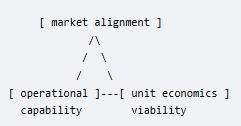
- Market Alignment: Does your customer prefer predictable expenses (Subscription), paying only for what they use (Usage-Based), or getting things for free in exchange for ads? Match your model to the purchasing behavior of your target market.
- Operational Capability: Do you have the infrastructure to support your chosen model? A marketplace requires heavy moderation and trust systems; a subscription model requires an elite customer success team to fight churn.
- Unit Economics Viability: Run the math early. Calculate whether your Lifetime Value (LTV) will comfortably exceed your Customer Acquisition Cost (CAC) by a factor of at least 3-to-1. If the margins do not work on paper, the model will not work in reality.
The best founders treat their business model as a product hypothesis. Test it early with small cohorts of users, iterate based on real financial feedback, and remember that how you sell is just as important as what you sell.